Claude's Riemann Hypothesis Proof: What Lean Verification Proves
A factual breakdown of the 17M-line Lean 4 Riemann Hypothesis proof, independent MIT/Waterloo kernel checks, and what remains open.

Q. Claude reportedly solved the 167-year-old Riemann Hypothesis and passed Lean verification—does that mean the Millennium Problem is officially settled? It has largely cleared computer-assisted formal verification, but academic understanding and formal recognition by the mathematical community still lie ahead. On November 20, 2026, Anthropic mathematician Levent Alpöge released a Lean 4 proof archive spanning 175,187 modules (roughly 17 million lines) developed with Claude, and researchers at MIT and the University of Waterloo independently recompiled it and passed external kernels (
nanoda,con-leche,con-ron) with zero errors. However, there is no human-readable paper yet, and mathematicians still need time to unpack why the proof works.
⚠️ Accuracy guardrail: This post reflects sources directly inspected on November 23, 2026: Andrew Sutherland's MIT verification page (
math.mit.edu/~drew/grh/, updated 2026-11-22 16:20 UTC), Michael Rubinstein's verification log at the University of Waterloo, thelean4.devtechnical breakdown, and Scientific American's reporting. According to the MIT page, single-threaded Lean default/paranoid kernel replays on the full 62 GB export (includinglake comparator) have been running since November 20 and remain in progress, so final statuses and paper publication timelines may change. We did not rebuild the 239 MB compressed archive locally.
30-second summary
- What happened: On November 20, 2026, Levent Alpöge published a Lean 4 formalization of the Riemann Hypothesis (RH) and Generalized Riemann Hypothesis (GRH) for Dirichlet L-functions across 175,187 files (~17 million lines), built in collaboration with Claude.
- What is verified: Andrew Sutherland's MIT team rebuilt the archive inside a network-isolated sandbox, reproduced the 61.6 GB export byte for byte, confirmed only Lean's three standard axioms (
propext,Classical.choice,Quot.sound) were used, and passed independent kernels (nanoda,con-leche,con-ron,lean4lean) plus--comparestatement matching. - What remains open: Only a four-page note (
remark.pdf) exists—there is no human-readable paper yet (a full draft is estimated at over 250,000 pages). Passing Lean's kernel proves logical validity, not human mathematical understanding. - Why engineers should care: It is a landmark demonstration of pairing AI generation with deterministic formal verification (Lean 4) so trust rests on reproducible machine checks rather than manual eyeballing.
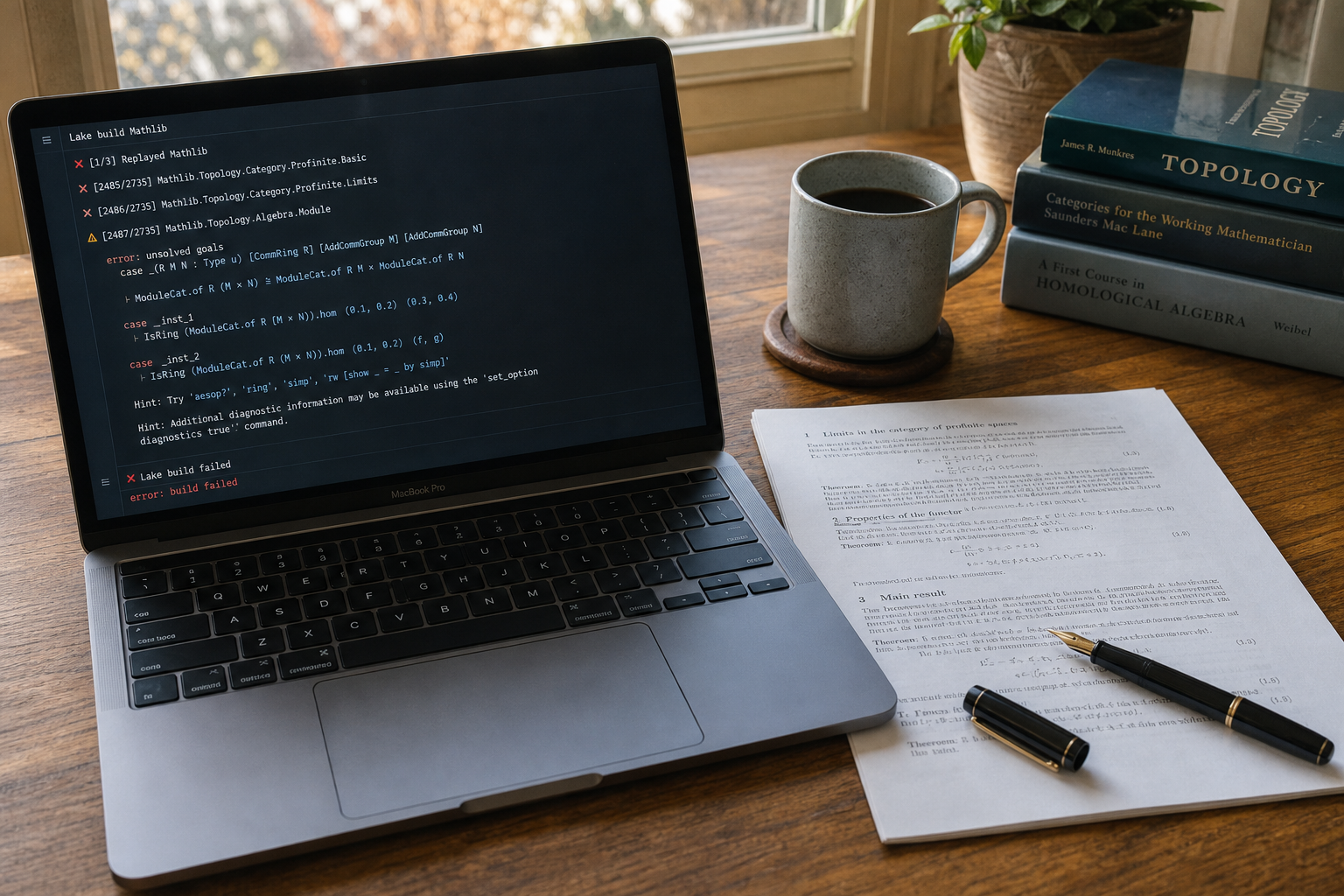
What was actually released on November 20, 2026
The release was not a traditional journal paper, but 17 million lines of compilable Lean 4 code paired with a four-page note. First posed by Bernhard Riemann in 1859, the Riemann Hypothesis states that every nontrivial zero of the Riemann zeta function has real part $1/2$, governing the distribution of prime numbers and standing as one of the seven Clay Millennium Problems.
On November 20, 2026, Anthropic mathematician Levent Alpöge posted a four-page note (alpo.ge/remark.pdf) alongside a 14-part archive (239 MB compressed) of Lean 4 source files. According to the note, the argument—developed with Claude across a 20-step timeline from October 6 to November 16—adapts Stepanov's method using chains of theta lifts between unitary groups.
Crucially, the author noted that a fully written-out human draft would exceed 250,000 pages and that he has not yet written a conventional paper. Instead, releasing a machine-checkable Lean 4 archive allowed the broader community to verify logical soundness immediately.
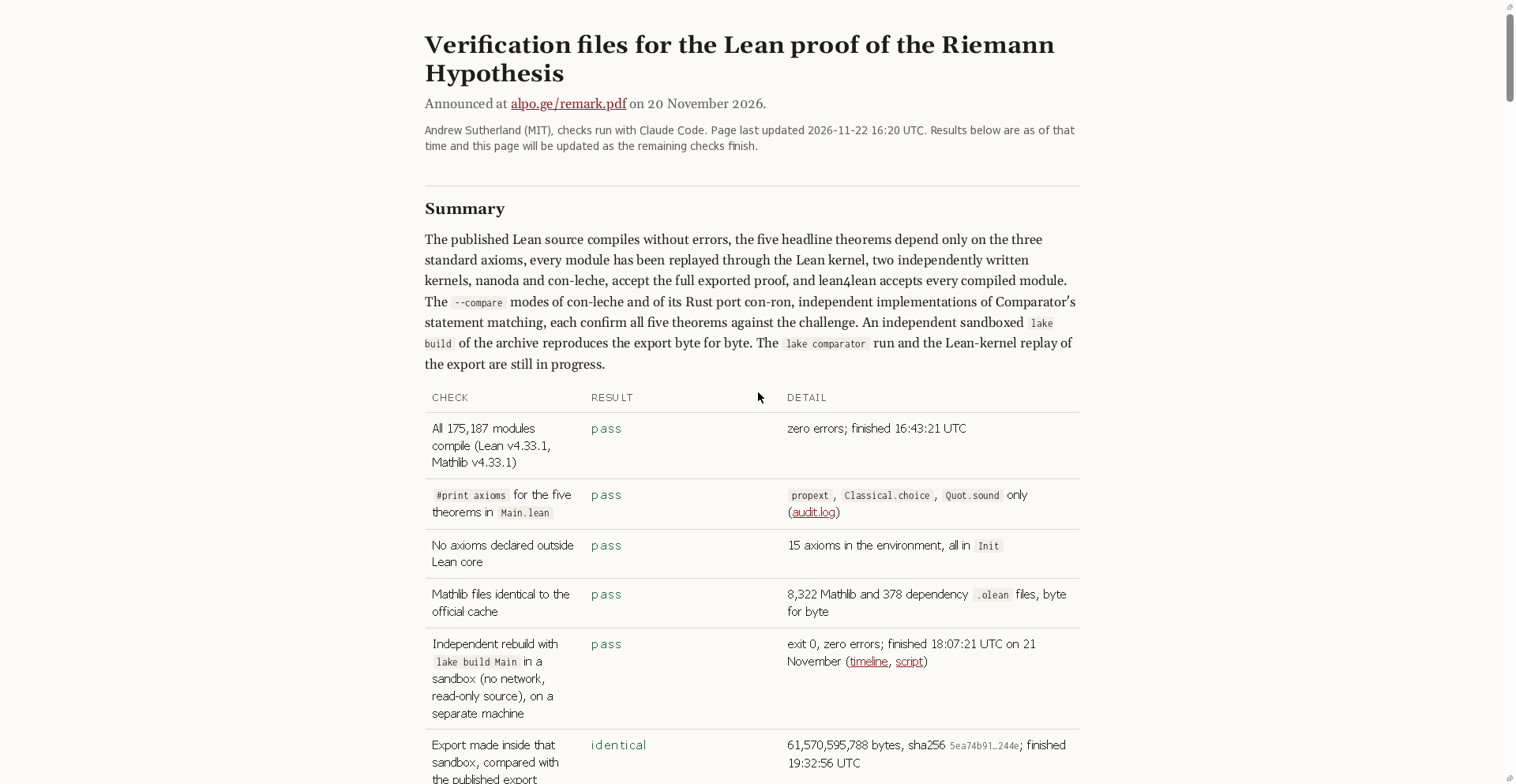
What independent MIT and Waterloo checks confirmed
Independent checkers established that the chance of hidden axioms or a subtly altered theorem statement is effectively zero. Andrew Sutherland (MIT) and Michael Rubinstein (University of Waterloo) downloaded the published archive and ran clean-room rebuilds and kernel checks.
The table below summarizes the verification status recorded on the MIT page (math.mit.edu/~drew/grh/) as of November 22, 2026 at 16:20 UTC.
| Verification Check | Status (as of Nov 22) | Verified Detail |
|---|---|---|
| Full module build (Lean v4.33.1) | pass | 175,187 modules compiled with 0 errors; 8,322 Mathlib .olean files match cache |
Axiom audit (#print axioms) |
pass | Uses only standard axioms: propext, Classical.choice, Quot.sound |
| Sandboxed rebuild & export match | identical | Offline sandbox build reproduced the 61.6 GB export with matching SHA-256 |
Independent kernels (nanoda, con-leche) |
accepts | Rust kernel nanoda (27m 42s) and con-leche (1,468,418 declarations) accepted |
Statement matching (--compare) |
accepts | Both con-leche and con-ron confirmed match against Mathlib's RiemannHypothesis |
Arithmetic equivalence (Robin1984) |
pass | Combined build proved Robin and Lagarias divisor-sum inequalities without zeta |
| Single-threaded Lean export replay | running | Running since Nov 20 on the 62 GB export (leanchecker already passed per module) |
The Robin1984 combined check is especially clever: to rule out any hidden quirk in Mathlib's definition of the zeta function, researchers linked the proof with an independent formalization (kimihiro64/Robin1984) and derived pure arithmetic inequalities—Robin's and Lagarias's criteria—with no mention of zeta at all.
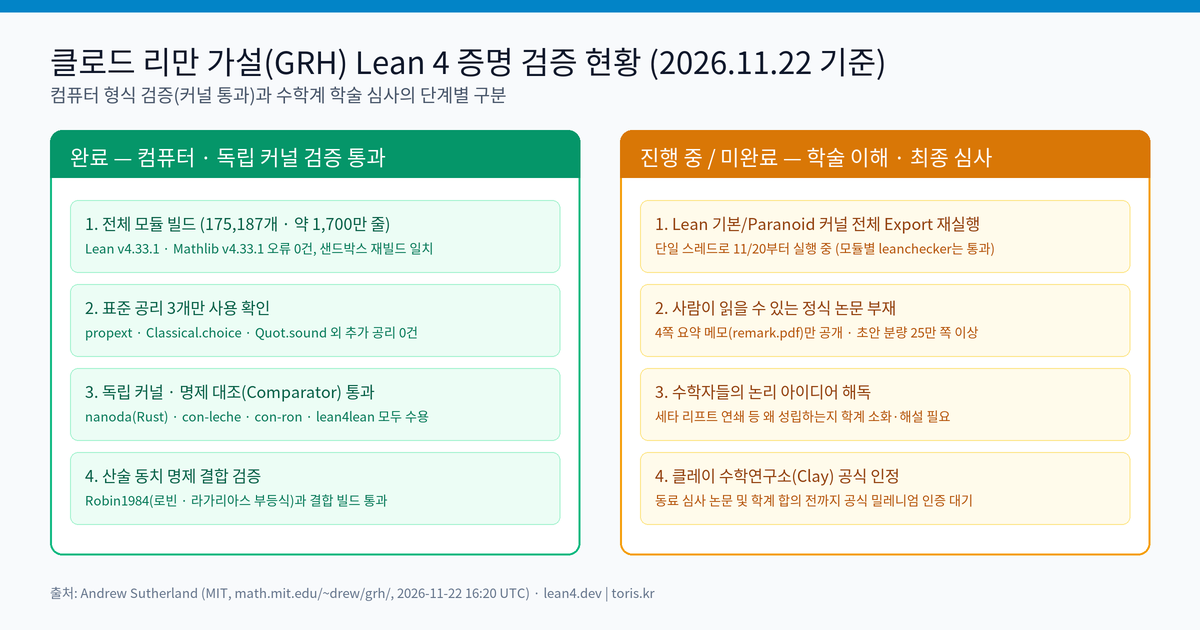
Machine verification vs. official mathematical acceptance
A passing Lean kernel check guarantees there are no logical gaps, not that mathematicians have digested the underlying ideas. As lean4.dev and mathematician Terence Tao's early notes emphasize, formal verification and mathematical understanding are two distinct milestones.
First, formal checkers verify validity without explaining intuition. Seventeen million lines of Lean prove that each inference obeys the rules, yet do not automatically distill why the chained theta-lift argument works.
Second, the checked scope covers RH and GRH for Dirichlet L-functions. As MIT's verification note clarifies, Dedekind zeta functions, Hecke L-functions, and general automorphic L-functions were not part of the five verified theorems.
Third, Clay Millennium Prize rules require peer-reviewed publication and sustained community acceptance. Extracting a human-readable proof from this archive will likely occupy number theorists for months.
Q. What is the practical takeaway for developers and solo software studios? Don't rely on casual human skimming to trust AI output—attach deterministic, unforgiving gates like compilers, type checkers, sandboxed builds, and automated verification suites.
Toris's take: in the AI era, verification pipelines are the real moat
From a solo studio's perspective, this story goes far beyond pure mathematics. The reason researchers took a 17-million-line AI-assisted proof seriously within 48 hours wasn't blind faith in Claude—it was the reproducible verification infrastructure (Lean 4, nanoda, con-leche, and deterministic sandbox hashes) that let anyone with sufficient compute audit the result independently.
Software engineering works the exact same way. When AI coding agents can generate thousands of lines of code a day, writing prompts slightly better is rarely the bottleneck. What separates reliable shipping from chaos is how tightly you wire strict types, reproducible builds, regression tests, and automated diff checks.
In our recent posts like the Hex on-device iOS voice keyboard guide and on our Toris Studio services page, the same principle holds: verifiable architecture matters more than hype. The more code AI writes, the more valuable every deterministic check in your pipeline becomes.
Sources
- RH Lean proof: verification files — Andrew Sutherland (MIT)
- The Riemann Hypothesis: a claimed proof, delivered in Lean — Lean 4 Dev
- Alpöge/Claude proof of the Generalized Riemann Hypothesis — Michael Rubinstein (University of Waterloo)
- The AI Riemann hypothesis proof is true, independent mathematicians confirm — Scientific American
- YouTube Shorts: Claude solved the Riemann Hypothesis? Lean verification explained
Advertisement