Claude Ship Beta: Automated PR Review, Fixes, and Policy Approvals
How Anthropic's Claude Ship combines Code Review, PR Steward, and Claude Approvals—covering /ship, token billing, observe mode, and ZDR/HIPAA limits.
Q. What is Claude Ship, and how does it differ from Claude Code or standalone Code Review?
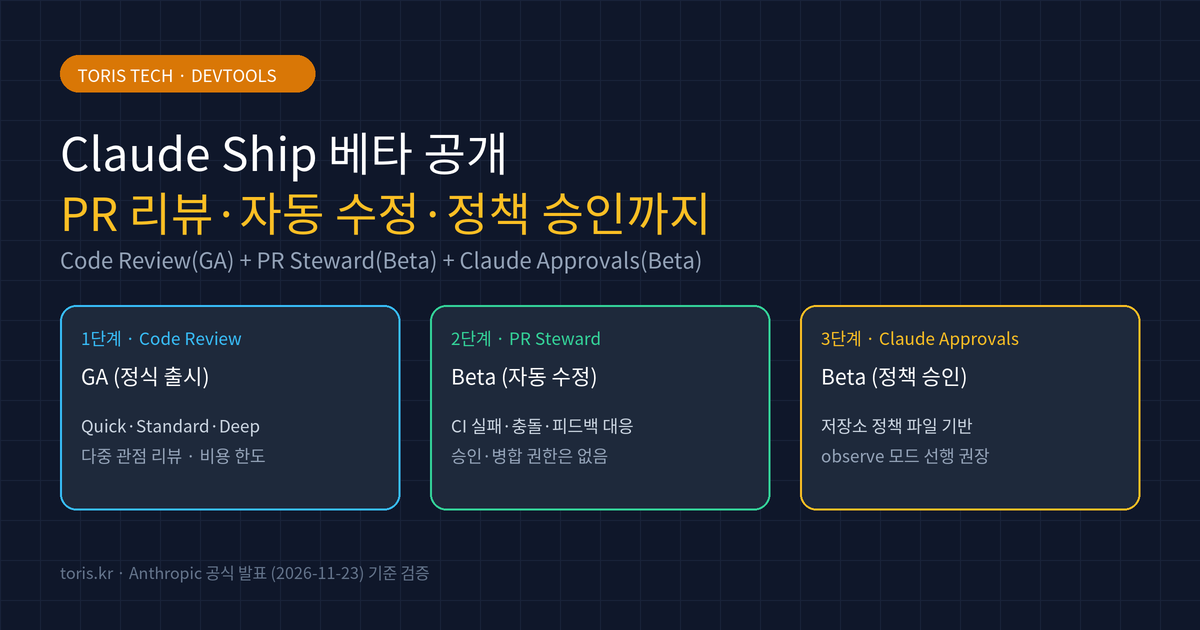
Claude Ship is Anthropic's beta workflow that automates pull request review, fixes, and policy-based approval decisions on GitHub using three agents: Code Review, PR Steward, and Claude Approvals. Unlike Claude Code, which helps write code, Claude Ship handles everything after a PR opens and is available on Claude Team and Enterprise plans per repository.
⚠️ Accuracy guardrail: Every fact below comes directly from Anthropic's official announcement (
Introducing Claude Ship), product page, and setup documentation checked on November 24, 2026. Actual token spend varies by PR size, review depth, and repository activity, so teams should verify real costs with a monthly spend limit on a pilot repository.
30-second summary
- Three-agent pipeline: Generally available
Code Reviewis now paired with two beta agents—PR Steward(automated fixes) andClaude Approvals(policy-driven sign-off). - Strict separation of duties:
PR Stewardresolves failing CI checks, merge conflicts, and review feedback, but cannot approve or merge pull requests; final sign-off follows repository policy files and branch protection rules. - Two entry points: Individual developers can run
/shipdirectly in Claude Code or the desktop app, while admins enable agents per repository inOrganization settings > Claude Shipwith monthly spend limits. - Eligibility exclusions: Organizations using Zero Data Retention (ZDR), HIPAA configurations, or customer-managed encryption keys (CMEK) cannot use Claude Ship.
Why automate what happens after a PR opens
As coding agents generate more of the codebase, the bottleneck shifts from writing code to reviewing, fixing, and merging pull requests. Jumping back into an older PR whenever CI fails or review comments arrive breaks developer momentum.
On Anthropic's own Claude Code team, where Claude writes most of the code and Code Review runs as part of the pipeline, merged PRs more than doubled between June and September while the share of reverted PRs dropped by over 40%. Claude Ship packages that post-PR loop into both a developer command (/ship) and repository-level governance.
Inside the three agents: review, fix, and approve
Rather than one monolithic bot, Claude Ship splits responsibilities across three agents that teams can adopt one by one on each repository.
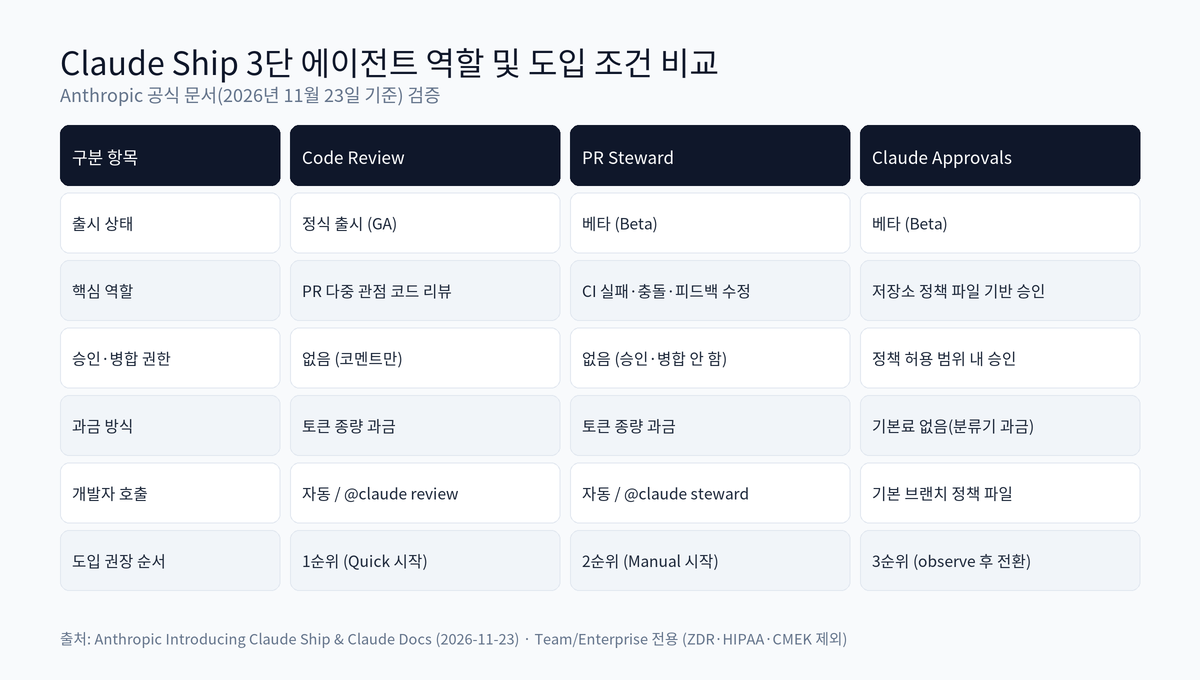
| Agent | Release status | Core responsibility | Boundaries & limits |
|---|---|---|---|
| Code Review | Generally available (GA) | Multi-lens codebase-aware PR review categorized as Important, Nit, or Pre-existing |
Does not push fixes or approve PRs |
| PR Steward | Beta | Fixes failing CI checks, merge conflicts, and human/tool feedback; comments changes and undo steps | Cannot approve or merge PRs; stops on @claude stop |
| Claude Approvals | Beta | Evaluates a repository policy file and natural-language classifiers to approve routine changes or require humans | Referencing Claude's review in policy triggers billed Code Review even in observe mode |
Because PR Steward runs on Anthropic infrastructure, teams do not need to maintain extra GitHub Actions workflow files. After each push, it documents what changed and how to revert it, and developers can steer it with @claude or halt it with @claude stop.
Developer /ship vs admin repository controls
Teams and individual contributors enter Claude Ship through two distinct workflows.

1) For developers: /ship inside Claude Code
- Once local changes are ready, run
/shipin Claude Code or the desktop app. - Claude pushes the branch, opens the PR, reviews the diff, and iterates on feedback and failing checks.
- Merging still respects the developer's GitHub permissions and branch protection rules, and
/shipcounts toward regular Claude Code usage.
2) For admins: repository-by-repository rollout
- Connect the Claude GitHub App under
Organization settings > Claude Ship, then configure review depth (Quick,Standard, orDeep), trigger timing, and monthly spend limits per repository. - Start
PR StewardinManualmode (triggered only by@claude stewardcomments) before turning it on automatically. - Deploy
Claude Approvalswith a policy file on the default branch in observe-only mode first so you can compare its decisions against human reviewers before enforcing it as a required check.
Billing, exclusions, and Enterprise credits
Claude Ship is billed on token usage rather than a flat seat add-on. Costs scale with PR count, diff size, review depth, trigger frequency, and how much remediation PR Steward performs.
One billing detail is easy to miss: Claude Approvals has no base fee, but custom classifiers consume tokens, and any approval policy that depends on Claude's review automatically runs a billed Code Review—even in observe-only mode.
Compliance limits also apply: Claude Ship is unavailable for organizations with Zero Data Retention (ZDR), HIPAA, or customer-managed encryption keys (CMEK). Eligible Claude Enterprise organizations can claim at least $10,000 in promotional Claude Ship credits (valid for 30 days after claiming) through January 15, 2027.
Toris's take
For solo builders and small teams, evaluate token costs and compliance boundaries before upgrading solely for repository automation. If you already use Claude Code, start by testing /ship on individual PRs to cut context-switching, and when rolling out to a team repo, cap monthly spend first and enable Code Review (Quick) → PR Steward (Manual) → Claude Approvals (observe-only) in sequence.
If ZDR or regulated workloads block Claude Ship, keep human-in-the-loop local review tooling instead. For browser-based plan and diff review see our Plannotator guide, for Bedrock/Vertex/Foundry defaults see our Claude Code Auto Mode guide, and for custom automation consulting visit Toris Services.
Sources
Advertisement