Claude MCP Servers Add Skills, Tasks & Elicitation Guide
Anthropic launched Skills over MCP (beta), Tasks and Elicitation (GA), and File Uploads on Nov 24, 2026. Learn the protocol specs and production checklist.
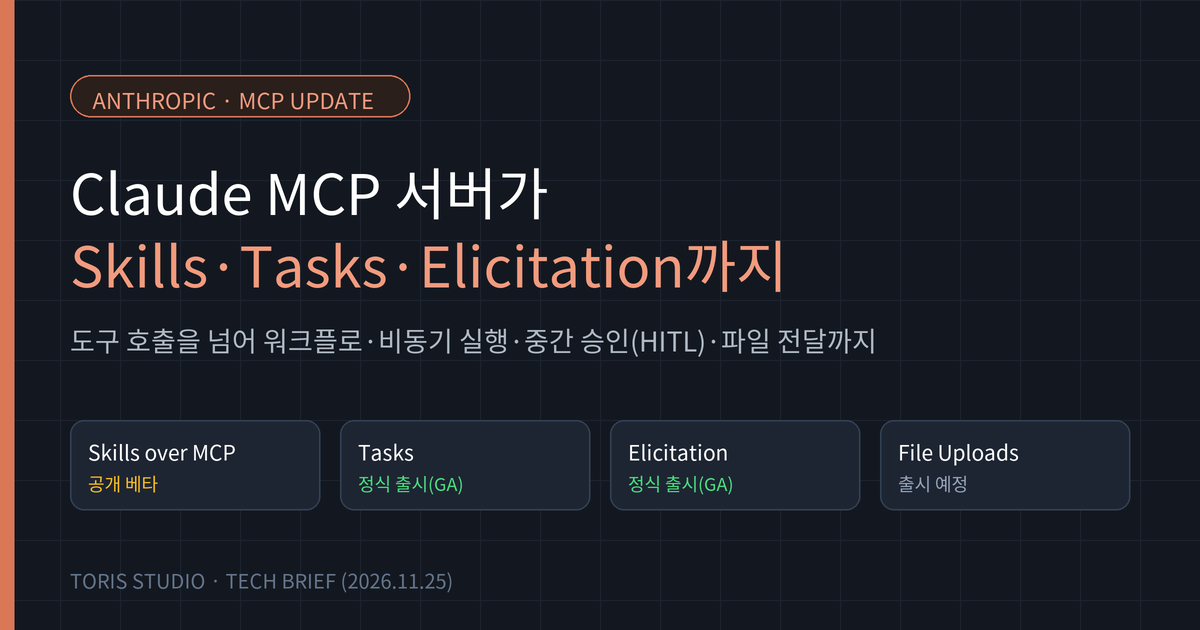
Q. How is shipping Skills, Tasks, and Elicitation different from an MCP server that only exposes Tools? With traditional MCP servers, Claude had to block until each tool call finished and rely on separate user prompts to know how to combine tools safely. With Anthropic's November 24, 2026 update, MCP servers can ship workflow playbooks via Skills over MCP (public beta) and handle background execution and mid-call user sign-off via generally available Tasks and Elicitation.
⚠️ Accuracy guardrail: This article was written on November 25, 2026, after directly inspecting Anthropic's official announcement (2026-11-24) and the official MCP extension specifications (
ext-skills,ext-tasks,elicitation). Because Skills over MCP is in public beta and File Uploads is rolling out soon, verify exact plan availability and schema fields in the latest official docs before production rollout.
30-second summary
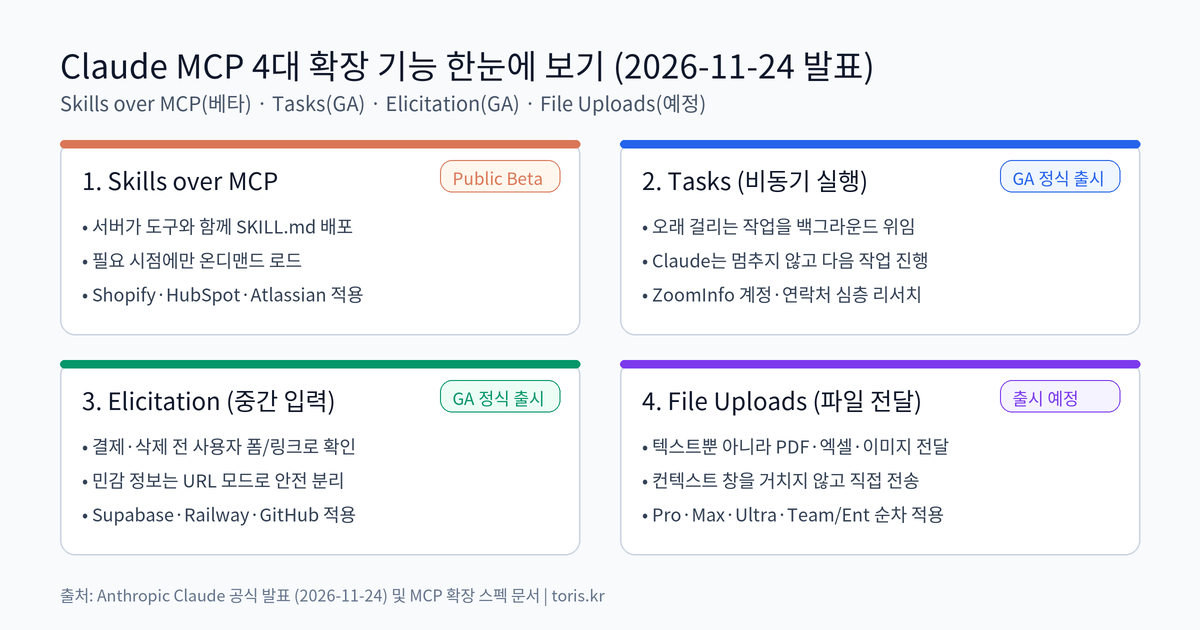
- Skills over MCP (Public Beta): MCP servers can publish
SKILL.mdplaybooks alongside tools and resources. Claude loads them on demand, keeping context overhead low and automatically staying in sync with server updates. - Tasks (GA): Servers can run long-running operations or full agent loops asynchronously, returning a durable
taskIdso Claude can keep working and pick up results when ready. - Elicitation (GA): Before consequential actions such as billing or deletion, servers can pause mid-call to request structured input via a
formor sensitive actions via aurl. - File Uploads (Coming Soon): Claude and Claude Code will pass PDFs, spreadsheets, and images directly to MCP servers without pushing raw payloads through the context window.
- Ecosystem scale: Anthropic reports over 700 million monthly SDK downloads and more than 10,000 MCP connectors for Claude.
Why Tools alone were not enough for production agents
Tool names and parameter descriptions explain what an action does, not the multi-step workflow or organizational policy required to use it safely.
Until now, MCP server authors exposed granular tools, leaving users to maintain separate system prompts or local instruction files to guide tool ordering and error recovery. As teams connected more servers, loading every tool definition upfront also consumed large portions of the context window.
Over the past year, Anthropic introduced Tool search (cutting multi-server context usage by over 85%), stateless server specs, Enterprise Managed Auth, and MCP Apps. This latest release completes the shift from simple data connectors to agentic orchestration—a trend also visible in our Google Workspace MCP and gwscli GA guide and Canva MCP GA guide.
Skills over MCP: Packaging domain expertise with tools
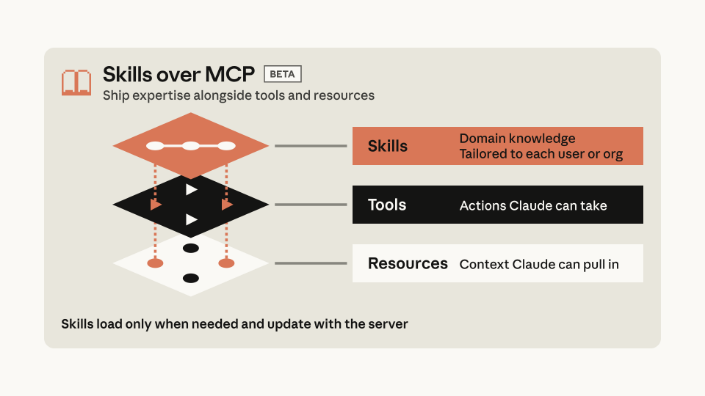
When a server declares the io.modelcontextprotocol/skills extension, clients fetch only metadata first and read SKILL.md files via resources/read only when needed.
According to the MCP Skills specification (SEP-2640 Final), a skill is a directory containing SKILL.md and optional supporting files. Clients call skills/list or skills/get to inspect the skill URI, YAML frontmatter (name, description), and a file manifest with SHA-256 digests and byte sizes. Actual instruction content is fetched only at execution time, preventing prompt bloat.
| Aspect | Separate prompts or local skill files | Skills over MCP (Public Beta) |
|---|---|---|
| Distribution & updates | Manual user installation and syncing | Ships and updates directly with the MCP server |
| Context efficiency | Often preloaded upfront | Loaded on demand via resources/read only when relevant |
| Early adopters | Individual custom workflows | Shopify (store setup), HubSpot (onboarding), Atlassian (org context), Carta (coming soon) |
| Availability | — | On by default for Pro, Max, Ultra in Claude & Claude Code (Team opt-in, Enterprise coming soon) |
Tasks and Elicitation: Long-running jobs and safe mid-call approvals
Tasks prevent timeouts on slow jobs by returning a durable handle, while Elicitation enforces human-in-the-loop confirmation before irreversible actions.
Synchronous tools/call requests risk client or proxy timeouts whenever a job takes more than a few seconds. Now generally available, Tasks (io.modelcontextprotocol/tasks) let a server return a CreateTaskResult (resultType: "task", taskId, pollIntervalMs, ttlMs) and execute in the background. Clients track progress (working, input_required, completed, failed, cancelled) via tasks/get polling or notifications/tasks. ZoomInfo uses Tasks to run multi-step account and contact research that previously required several back-and-forth prompts.
When a server needs user input mid-flight, it enters input_required and issues an elicitation/create request, resuming via tasks/update once answered. The specification enforces a strict split between two modes:
formmode: Collects flat structured values (strings, numbers, booleans, enums) validated by JSON Schema inside the client UI. Servers must never request passwords, API keys, or payment credentials in form mode.urlmode: Redirects the user out-of-band to an external URL so sensitive credentials never pass through the MCP client.
In production, Supabase uses Elicitation to confirm costs before creating paid projects or running destructive SQL, Railway confirms before deleting services, and GitHub asks users to type a repository's name before deletion.

File Uploads and a checklist for plugin authors
Once File Uploads rolls out, PDFs, spreadsheets, and images will travel straight to MCP servers without crowding the LLM context window.
Passing large spreadsheets or binary documents as extracted text wastes tokens and loses formatting. The upcoming File Uploads extension lets Claude and Claude Code transfer files directly to compatible servers.
If you maintain an internal or marketplace MCP server today, three practical steps stand out. First, bundle recurring multi-tool procedures into SKILL.md playbooks exposed via skills/list and skills/get. Second, move slow research, build, or batch operations onto Tasks so dropped connections do not lose progress. Third, protect billing, deletion, and external-write tools with protocol-level Elicitation prompts rather than relying solely on system-prompt warnings.
Toris's take
For solo developers and small teams building MCP servers, Elicitation and Skills over MCP offer the highest immediate return.
Granting an agent database or deployment access with only a prompt instruction to "be careful" is brittle. Putting a hard Elicitation confirmation gate in front of destructive or paid actions—and bundling your team's exact tool playbooks into Skills over MCP on the server side—keeps client prompts lean while making production workflows measurably safer.
Sources
Advertisement